
Maa Vaishnvi or Mata Vaishno Devi is considered to be an incarnation of the three Supreme Powers;- Maa Saraswati as “Supreme Power of Creation”, Maa Kali as “Supreme Power of Dissolution” and Maa Lakshmi as “Supreme Power of Maintenance”.
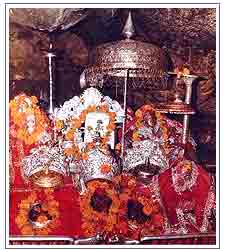
Maa Vaishno Devi – Pindis
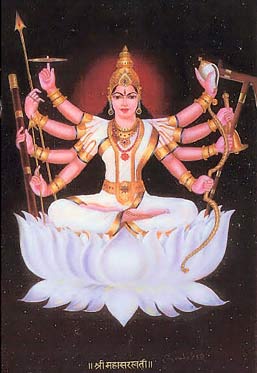
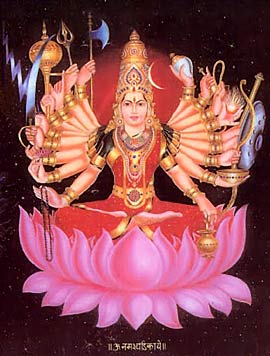
As per the legend, during the period when the Goddess was busy in annihilating the Asuras, Her three main manifestations Maa Maha Kali, Maa Maha Lakshmi and Maa Maha Saraswati got together one day and pooled their collective Tejas or spiritual strength. A stunningly bright light emanated from the place where the Tejas of the three manifestations coalesced and a beautiful young girl emerged out of this Tejas. The young girl asked them, “Why have I been created?” The Devis explained to her that they had created her so that she would live on earth and spend her time in upholding righteousness.
The Devis added, “Now, go and take birth in the house of Ratankar and his wife who reside in the southern part of India, and who are great devotees of ours. Live on earth. Uphold righteousness and evolve yourself spiritually so that you reach higher levels of consciousness. Once you have attained the appropriate level of consciousness you will merge into Vishnu and become one with him.” So saying they blessed the girl. Sometimes later a very beautiful girl child was born to Ratankar and his wife. The couple named the child Vaishnavi. The girl right from her childhood displayed a hunger for knowledge which was like a vortex and which no amount of teaching and learning could sufficiently satiate.
Devi Maa
Subsequently, Vaishnavi started looking into her inner self for knowledge, and soon learned the art of meditation and realized that meditation and penance only could bring her close to her greater objective. Vaishnavi thus relinquished all household comforts and went deep into the forest for Tapasaya (meditation). Meanwhile, Lord Rama, during his fourteen years of exile happened to visit Vaishnavi who recognized him immediately as no ordinary being but the incarnation of Lord Vishnu, and immediately asked him to merge her into himself so that she could become one with the supreme creator.
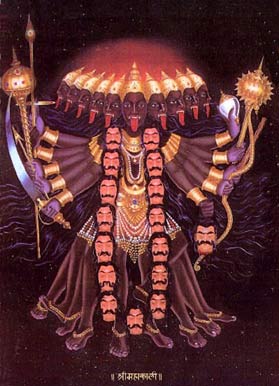
However Lord Rama, knowing that it was not the appropriate time, dissuaded her by saying that he would visit her again after the end of his exile, and at that time if she succeeded in recognizing him, he would fulfill her wish. True to his words, Rama visited her again after being victorious in the battle, but this time he did so in the disguise of an old man. Unfortunately, Vaishnavi was unable to recognize him this time and was distraught. Upon this, Lord Rama consoled her that the appropriate time for her being one with the creator had not come, and that time would come eventually in ‘Kaliyug’ when He (Rama) would be in his incarnation of ‘Kalki’. Rama also directed her to meditate, and set up an Ashram at the base of Trikuta hills, to elevate her level of spirituality so as to bless mankind and rid the poor and destitute of their sufferings.Only then would ‘Vishnu’ merge her into himself. Vaishnavi, immediately set off for the northern part and after immense hardships, reached the foot of the Trikuta Hills. After reaching there she set up her ashram there and began to meditate.
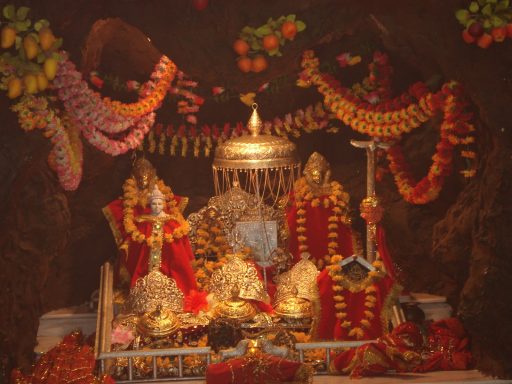
Jai Mata Vaishno Devi JI
As predicted by Lord Rama, her glory spread far and wide, and people began to flock to her Ashram to seek her blessings. As time passed, a MahaYogi named Guru Gorakh Nath who had a vision of the episode between Lord Rama and Vaishnavi in the retrospective time frame, became curious to find out whether Vaishnavi has been able to attain a high level of spirituality or not. He, therefore, sent his most able disciple ‘Bhairon Nath’ to find out the truth. Bhairon Nath on locating the ashram started observing Vaishnavi secretly, and realised that though a ‘Sadhvi’ she always carried bow and arrows with her, and was always surrounded by langoors (apes) and a ferocious looking lion. Bhairon Nath was enamored by Vaishnavi’s extraordinary beauty, and losing all good sense he began to pester Vaishnavi to marry him. Meanwhile a staunch devotee of Vaiashnavi, Mata Sridhar organised a Bhandara (Community meal) in which the whole village and Guru Gorakh Nath along with all his followers including Bhairon were invited. During the course of Bhandara Bhairon Nath attempted to grab Vaishnavi but she tried her best to daunt him. On failing to do so, Vaishnavi decided to flee away into the mountains to continue her Tapasaya undisturbed. Bhairon Nath however chased her to her destination.
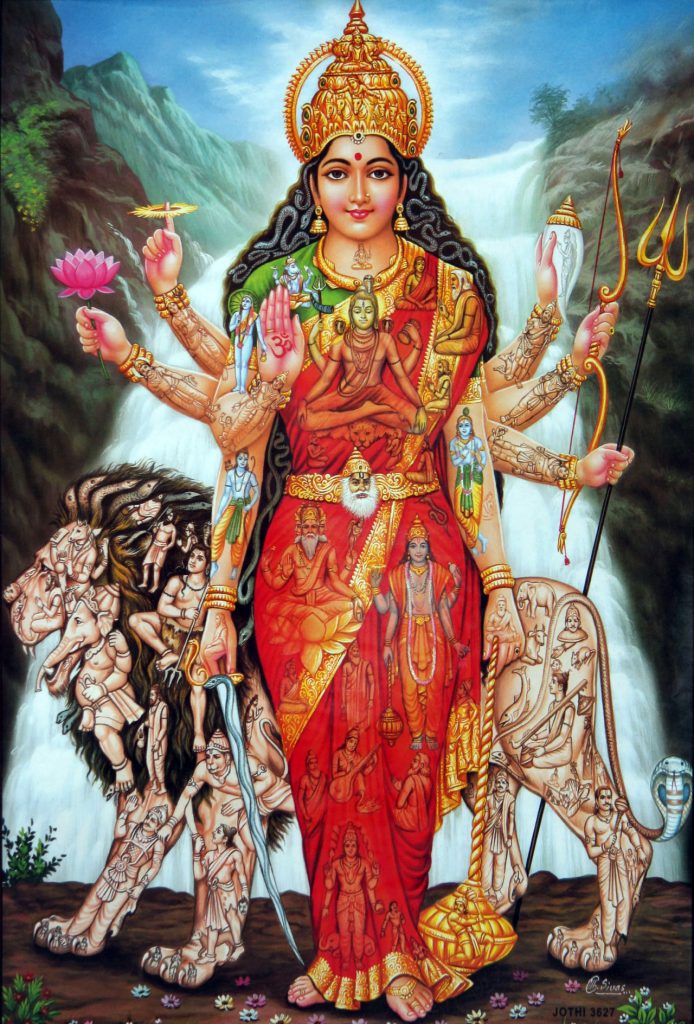
Maa Vaishnavi Mahamaya
The goddess after halting at (present day) Banganga, Charan Paduka, and Adhkwari, finally reached the holy cave Shrine. When Bhairon Nath continued to follow her despite the goddess trying to avoid a confrontation, the goddess was compelled to kill him. Bhairon Nath met his ultimate fate when the goddess, just outside the mouth of the cave, beheaded him. The severed head of Bhairon fell with a force at a distant hilltop. Bhairon Nath upon death realised the futility of his mission and prayed to the deity to forgive him. The almighty Mata ( Mother Goddess) had mercy on Bhairon and gave him a boon that every devotee of the goddess would have to have the Darshans of Bhairon after having the Darshans of the Goddess and only then would the yatra of a devotee be complete. Meanwhile, Vaishnavi decided to shed off her human form and assuming the face of a rock she immersed her self into meditation forever. Thus Vaishnavi, in the form of a five and a half feet tall rock with three heads or the Pindies on the top is the ultimate destination of a devotee. These Pindies constitute the Sanctum Sanctorum of the holy cave known as the shrine of Shri Mata Vaishno Devi Ji, which is revered by one and all.
Send Your Prayers
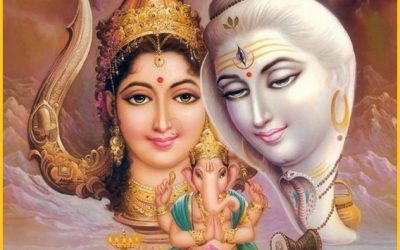
Maa Parvati – the Shakti Aspect of the Mother Goddess
Maa Parvati is the Shakti aspect of the Mother Goddess, she forms the trinity of Hindu Goddesses along with Goddess Lakshmi (Goddess of wealth and prosperity) and Goddess Saraswati (Goddess of learning and knowledge). This gentle and nurturing aspect of Maa Shakti is...
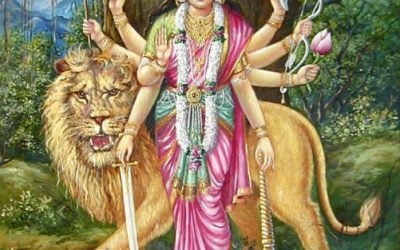
Navratri Nav Durga Pooja, Maa Navdurga Mantras
Navratri or Nav Ratri means 9 nights dedicated for 9 divine forms of Maa, Adishakti Maa Durga. Maa Shailaputri Day of worship: 1st day of Navratri Governing planet: Moon Mantra: Om Devi Shailaputryai Namah ॐ देवी शैलपुत्र्यै नम Iconography: She rides a bull, carrying...
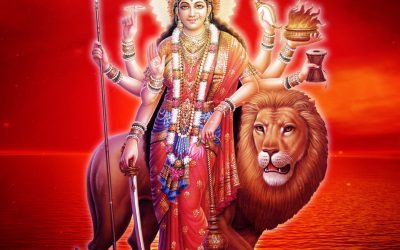
Sharad Navratri Pooja, Navaratri Festival 2016, October 1 to 11 October, 2016
Navratri is a festival of worship and devotion. Navratri is the nine days festival celebrated to worship Mother Goddess Maa Durga. Nav’ means Nine and ‘Ratri’ means Nights, hence the name of the Nine-Night festival also. During these nine nights and ten days, 9...
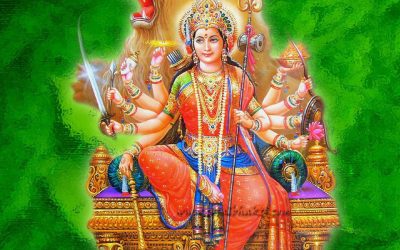
Vasant Navratri Pooja, Chaitra Navaratri Festival April 8th to April 16th, 2016
Nav’ means Nine and ‘Ratri’ means Nights, hence the name of the Nine-Night festival. Navratri comes twice a year (there are also two secret navaratri - gupta navratri), in April and october. Chaitra Navratri, also popular as Chait Navratras, is the nine-day festival...
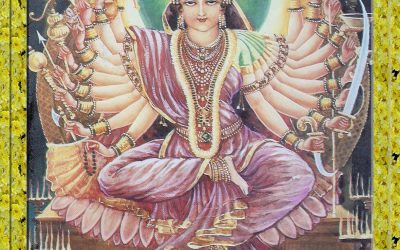
Shardiya Navratri Pooja, Navaratri Festival 2015, October 13 to 22 October, 2015
Navratri is a festival of worship and devotion. Navratri is the nine days festival celebrated to worship Mother Goddess Maa Durga. Nav’ means Nine and ‘Ratri’ means Nights, hence the name of the Nine-Night festival also. During these nine nights and ten days, 9...
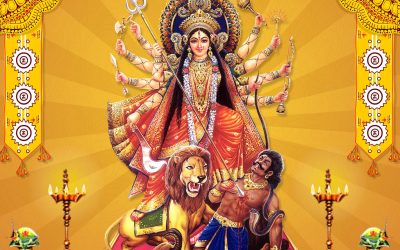
Mahishasura Mardini Stotram (Hindi) – महिषासुर मर्दिनी स्तोत्र
महिषासुर मर्दिनी स्तोत्र ==================== श्री गणेशाय नमः अयि गिरिनंदिनि नंदितमेदिनि विश्वविनोदिनि नंदनुते गिरिवर विंध्य शिरोधिनिवासिनि विष्णुविलासिनि जिष्णुनुते | भगवति हे शितिकण्ठकुटुंबिनि भूरि कुटुंबिनि भूरि कृते जय जय हे महिषासुरमर्दिनि रम्यकपर्दिनि शैलसुते ||...
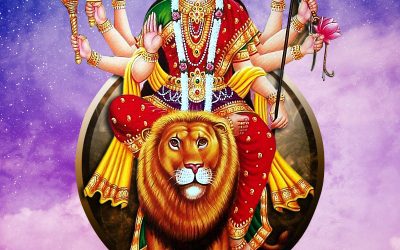
Chaitra Navaratri Pooja, Chaitra Navaratri Festival 2015, March 21 to March 28, 2015
Nav’ means Nine and ‘Ratri’ means Nights, hence the name of the Nine-Night festival. Navratri comes twice a year (there are also two secret navaratri - gupta navratri), in April and october. Chaitra Navratri, also popular as Chait Navratras, is the nine-day festival...
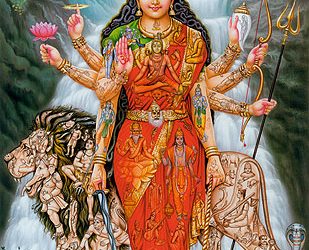
Jai Maa
ॐ ऐं ह्रीं श्रीं क्रीं | उमा पार्वती आनंदमयी || कालि दुर्गे नमो नमः | माँ कालि दुर्गे नमो नमः || ۞۞۞۞۞۞۞۞۞۞۞۞۞۞۞۞ Auṃ aiṃ hrīṃ śrīṃ krīṃ l Umā Pārvatī ānandamayī ll Kāli Durgē namō namaḥ l Mām̐ Kāli Durgē namō namaḥ ll...
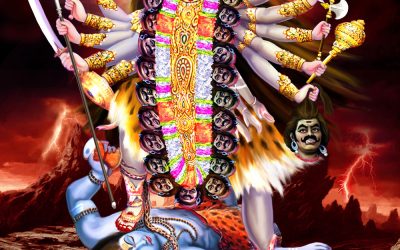
Argala Stotram from Devi Mahatmayam – Jayanti Mangala Kali
Jaya Tvam Devi Caamunndde Jaya Bhuu-Taapa-Haarinni | Jaya Sarva-Gate Devi Kaalaraatri Namostu Te ||1|| Jayantii Manggalaa Kaalii Bhadrakaalii Kapaalinii | Durgaa Shivaa Kssamaa Dhaatrii Svaahaa Svadhaa Namostu Te ||2|| Madhu-Kaittabha-Vidhvamsi Vidhaatr-Varade Namah |...