Tag Archives: Hindu Goddess

Maa Kali – Hindu Goddes, Kali Ma, Kali Mata, Goddess Kali

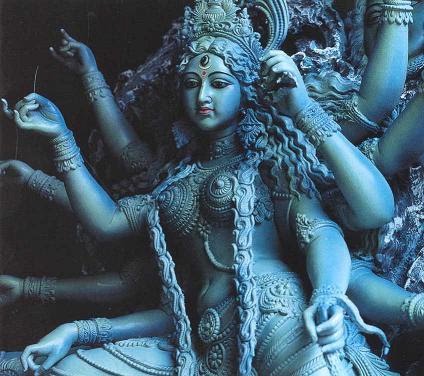
On a moonless night in autumn, when the rest of India celebrates Deepawali, Kali-Chamunda is worshipped in Bengal. Her image shows a beautiful, dark skinned woman but she wears clothes and jewellery made of skulls and human hands and carries a bloody Kharga scimitar and a snake. Her eyes are bloodshot and she stands on the chest of the recumbent figure of Shiva and her tongue hangs out.

Maa Kali

Goddess Kali

It is said that after drinking the blood of Raktaveeja she was so maddened by the battle that she could not stop her dance of destruction. The only way Shiva could stop her was by lying down in her path. As kali stepped on his chest she realised what she had done and stuck out her tongue in shame.
Passionate, impulsive Kali is also described as the first tongue of flame in a yajna fire and is in many ways the antithesis of a calm professional fighter like Durga or Chandika. There are temples to the Devi and even to the Matrikas and the Dasa Mahavidyas all across the country.

Among the most sacred are the Kali Ghat and Dakshineshwar temples in Kolkata and the Kamakshya temple in Kamrup where Kali is worhipped. There is the Meenakshi temple in Madurai and South. The hill top shrine of Vaishno Devi near Jammu is the most popular Devi temple in the north. One of the oldest Kali images can be seen at the Kali temple inside the Amber Fort near Jaipur. The Kali image was brought here from Jessore in Bengal by Raja Man Singh during the reign of the Mughal emperor Akbar.
Like her varied and highly contrasting persona that ranges from a loving provider and mother to a merciless, bloodthirsty figher, the Devi has many names. The Adya Shakti, the primal energy is the Uma-Sati-Parvati-Chandika-Chamunda-Kali-Durga of the myths. She is also praised as Ishani, wife of Shiva who is called ishan; Annapurna, the provider and Girija, the mountain born. She is Rudrani, the wife of Rudra; Haimavati, daughter of the snowy mountains and Bhairavi, the terrible. Slso Ambika, the mother; Vijaya, the victorious, Gauri and Kaushiki, the golden skinned and Sarva Mangala, auspicious. She is Shakhambari, the one who nourishes the world wiht her body; Kamakshi, the love eyed goddess; Meenakshi, with eyes shaped like fished, and Kapalini, the ascetic.

Posted in Hindu God, Hinduism, Maa, Maa Kali | Tagged , , , , , | 1 Comment

Navratri, Worship Festival of Mother Goddess in Hinduism

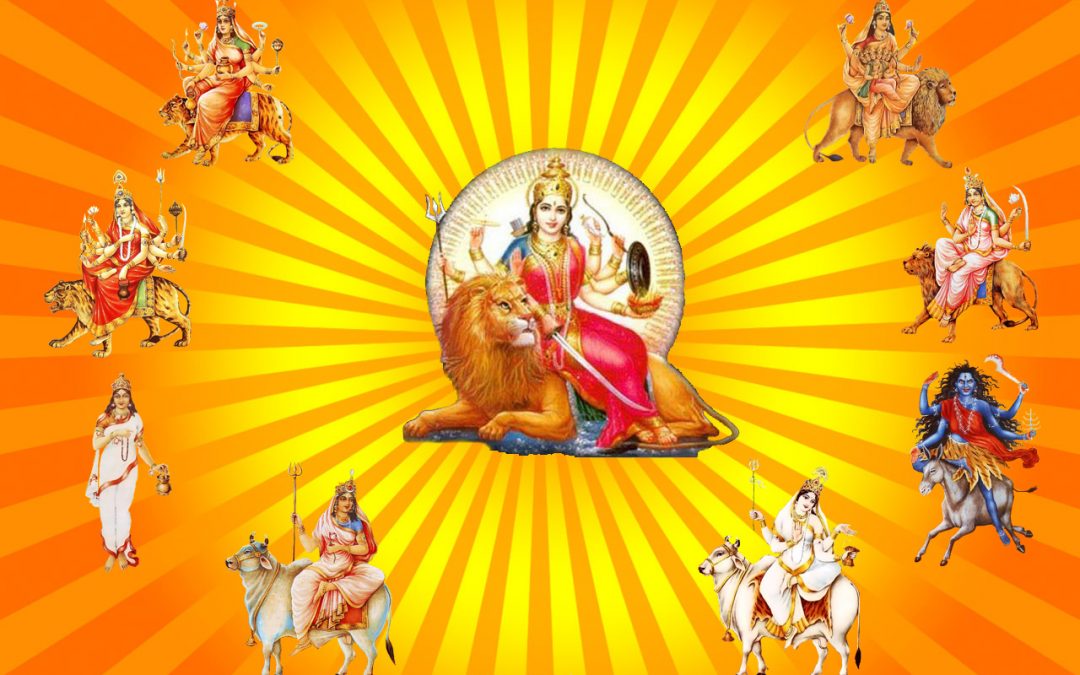
The Navratri festival is celebrated with true devotion and purity all over the country. People from various sections of the society irrespective of caste and creed celebrate this festival by visiting temples and offering pujas at the Mother’s feet. The rituals of this festival are that the nine days and nine nights of Navratri are totally dedicated to the Mother Goddess and includes observing a fast, japa (chanting of holy mantras in the honor of the Goddess), chanting religious hymen (Bhajans), prayers, meditating and reciting the sacred texts relevant to Maa Durga. During this period most of the Hindus visit different Mata temples and offer their sincere prayers to the Mother Goddess. The main ritual of this festival is placing images of the Goddess in homes and temples and worshiping them.

Devi Durga Maa

Jai Maa Durga

The following 9 forms of Maa Durga are worshiped during these nine days as Nava Durga Goddesses:


*****************************Jai Mata Ki*****************************

*****************************Jai Mata Ki*****************************

Posted in Durga, Hinduism, Maa, Maa Kali | Tagged , , , , | Leave a comment

Ganesh Chaturthi, Birthday of Lord Ganesha – The God Wisdom and Prosperity

Ganesh Chaturthi is celebrated on the birthday of God Ganesha, the god of wisdom and prosperity on the fourth day of the moons bright fortnight, or period from new moon in the lunar month of Bhadrapada. The celebration of Ganesh Chaturthi continue for five, seven, or ten days. Some even stretch it to twenty one days, but ten the most popularly celebrated. In the tradition of the right hand path the first day is the most important. In the left hand path tradition the final day is most important.

Lord Ganesha Statues for Worship

Lord Ganesha Wearing Pagdi (Turban) Shree Ganesh Chaturthi Woship

Ganesha is the god of wisdom and prosperity and is invoked before the beginning of any auspicious work by the Hindus. It is believed that for the fulfillment of one’s desires, his blessing is absolutely necessary. According to the mythology, he is the son of Shiva and Parvati, brother of Kartikeya – the general of the gods, Lakshmi – the goddess of wealth and Saraswati-the goddess of learning. There are numerous stories in Hindu mythology, associated with the birth of this elephant-headed god, whose vehicle is the Mooshak or rat and who loves Modaks.

Lord Ganesha is worshiped with various names & forms as here mentioned in a Marathi prayer given below:-

Gananayaka Ganadaivataya Ganadaksha Yadhimahi
Guna shariraya Guna Manditaya Guneshanay Dhimahi
Gunaditaya Gunadhishaya Guna pravishtaya Dhimahai
Ekadantaya Vakratundaya Gauri tanahaya yadhi mahi
Gajeshanaya Bhalchandraya shree ganeshaya dhimahi
{Ekadantaya Vakratundaya Gauri tanahaya yadhi mahi
Gajeshanaya Bhalchandraya shree ganeshaya
dhimahi

Gaanachaturaya ganaapranaya gaanantaratmane gaanot
sukhay
Gaanamattaya gannott sukha mana se
Guru pujitaya, Guru daivataya, Guru kulasthaine
Guru Vikramaya, Guiyya pravaraya Gurave guna gura ve
Gurudaitya kalakchetre, Guru dharma sada rakdhyaya
Guru putra paritratre Guru pakhand khand khaya
Geet saraya, Geet tatvaya Geet kotraya dhimahi
Gudha gulfaya, Gandha Mattaya Gojaya pradaya dhimahi
Gunaditaya Gunadhishaya Guna pravishtaya Dhimahai
Ekadantaya Vakratundaya Gauri tanahaya yadhi mahi
Gajeshanaya Bhalchandraya shree ganeshaya dhimahi
{Ekadantaya Vakratundaya Gauri tanahaya yadhi mahi
Gajeshanaya Bhalchandraya shree ganeshaya
dhimahi ………………………….

Posted in Ganesha, Hindu God, Hinduism | Tagged , , , , , , , , | 1 Comment

THE HINDU PANTHEON

THE COSMIC TRINITY

  1. Surya, god of Energy.
  2. Agni, god of Fire.
  3. Vayu, god of Air.

THE HINDU TRINITY

  • The Creator, his manifestations and his family

Brahma, creator of the universe
Saraswati, his consort, goddess of learning
Swan, Saraswati’s vehicle


  • The Preserver, his manifestations and his family

Vishnu, preserver of the universe
Lakshmi his consort, goddess of wealth
Matsya the fish, first incarnation of Vishnu
Kurma the tortoise, second incarnation of Vishnu
Varaha the boar, third incarnation of Vishnu
Narasimha, half lion, half man, fourth incarnation of Vishnu
Vamana the dwarf, fifth incarnation of Vishnu
Parashurama, the slayer) sixth incarnation of Vishnu
Rama, the king who vanquished Ravana, seventh incarnation of Vishnu
Krishna, the cowherd warrior, eighth incarnation of Vishnu
Buddha, the Enlightened, ninth incarnation of Vishnu
Kalki, the last (yet to come) incarnation of Vishnu

Balarama, brother of Krishna
Lakshmana, brother of Rama
Ravana, the ten-headed king of Lanka
Radha, devotee-lover of Krishna
Rukmini, wife of Krishna
Sita, daughter of Janak, and wife of Rama

Hanuman, the monkey-god of the Ramayana
Jatayu, saviour of Sita
Garuda, vehicle of Vishnu and Lakshmi
Sheshanaga, the serpent-king on whom Vishnu rests

  • The Destroyer, his manifestations and his family

Shiva, destroyer of the universe
Mahesh, another namefor Shiva
Bhairav, the ascetic form of Shiva
Raudradeva, the angry form of Shiva
Nataraja, Shiva as the lord of dance
Parvati, Shiva’s consort and Shakti female energy
Durga, a form of Shakti, astride a lion
Kali, destroyer of evil, anotherform of Shakti
Meenakshi, at Madurai, a representation of Shakti or Parvati
Uma, daughter of the mountains, wife of Shiva (Parvati)
Ganesha, elephant-headed son of Shiva and Parvati, remover of obstacles
Kartikeya, son of Shiva and Parvati, warrior-annihilator
Nandi the bull, Shiva’s vehicle

NAVAGRAHA OR THE NINE PLANETS

  • Surya, the sun
  • Soma, the moon
  • Buddha, Mercury
  • Sukra, Venus
  • Mangala, Mars
  • Brahspati, Jupiter
  • Shani, Saturn
  • Rahu, dragon’s head
  • Ketu, dragon’s tail
Posted in Hindu God, Hinduism | Tagged , , , , | 1 Comment

Hindu Goddess Maa Durga

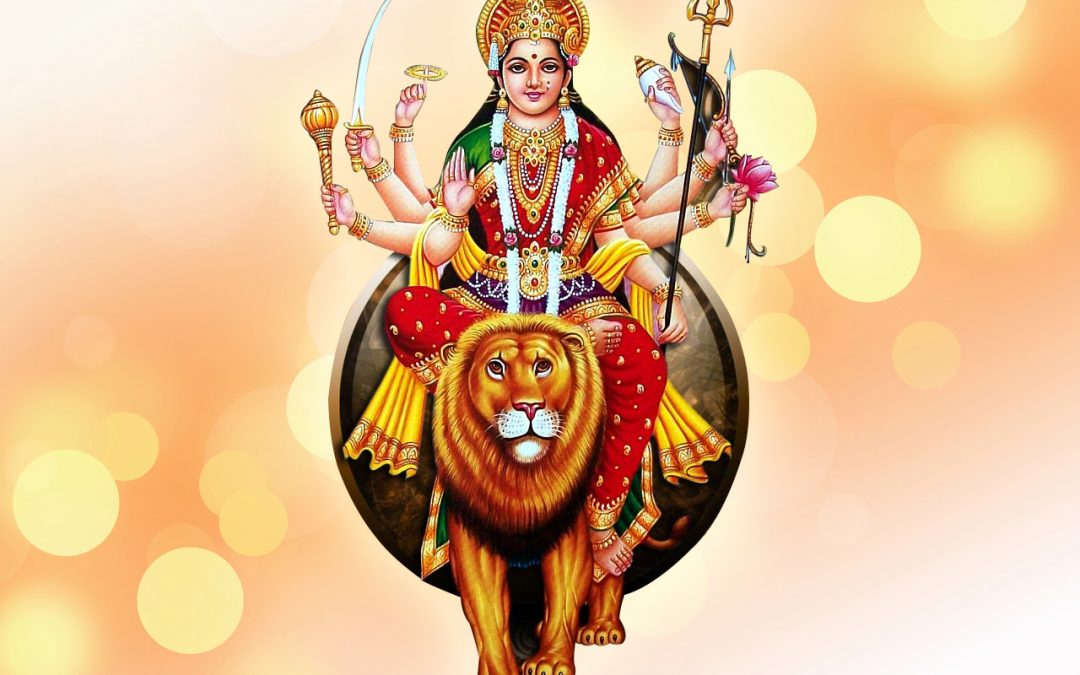
In Hinduism, the goddess Durga (”the inaccessible” or “the invincible”) or Maa Durga (Mother Durga) “one who can redeem in situations of utmost distress”. Durga is a form of Devi, the supremely radiant goddess, a superheroine depicted as having 10 arms, riding a lion or a tiger, carrying weapons (including a Lotus flower), maintaining a meditative smile, and practicing mudras, or symbolic hand gestures.

Hindu Goddess Maa Durga

Hindu Goddess Maa Durga

An embodiment of creative feminine force (Shakti), Durga exists in a state of svātantrya (dependence on the universe and nothing/nobody else, i.e., self-sufficiency) and fierce compassion. Durga is considered by Hindus to be an aspect of Kali, and the mother of Ganesha, and Kartikeya. She is thus considered the fiercer, demon-fighting form of Shiva’s wife, goddess Parvati. Durga manifests fearlessness and patience, and never loses her sense of humor, even during spiritual battles of epic proportion.

Posted in Maa | Tagged , , , , | Leave a comment